

Quick Answer: If your Florida business receives a tax audit notice, organize your financial records, respond before the deadline, and contact a qualified CPA. Florida businesses face audits from both the Florida Department of Revenue (for sales tax) and the IRS (for federal taxes), and each process follows different rules and timelines.
What Triggers a Tax Audit for a Florida Business?
Florida businesses can be selected for a state audit by the Florida Department of Revenue (DOR), a federal audit by the IRS, or both. The triggers differ depending on which authority initiates the review.
Common IRS Audit Triggers
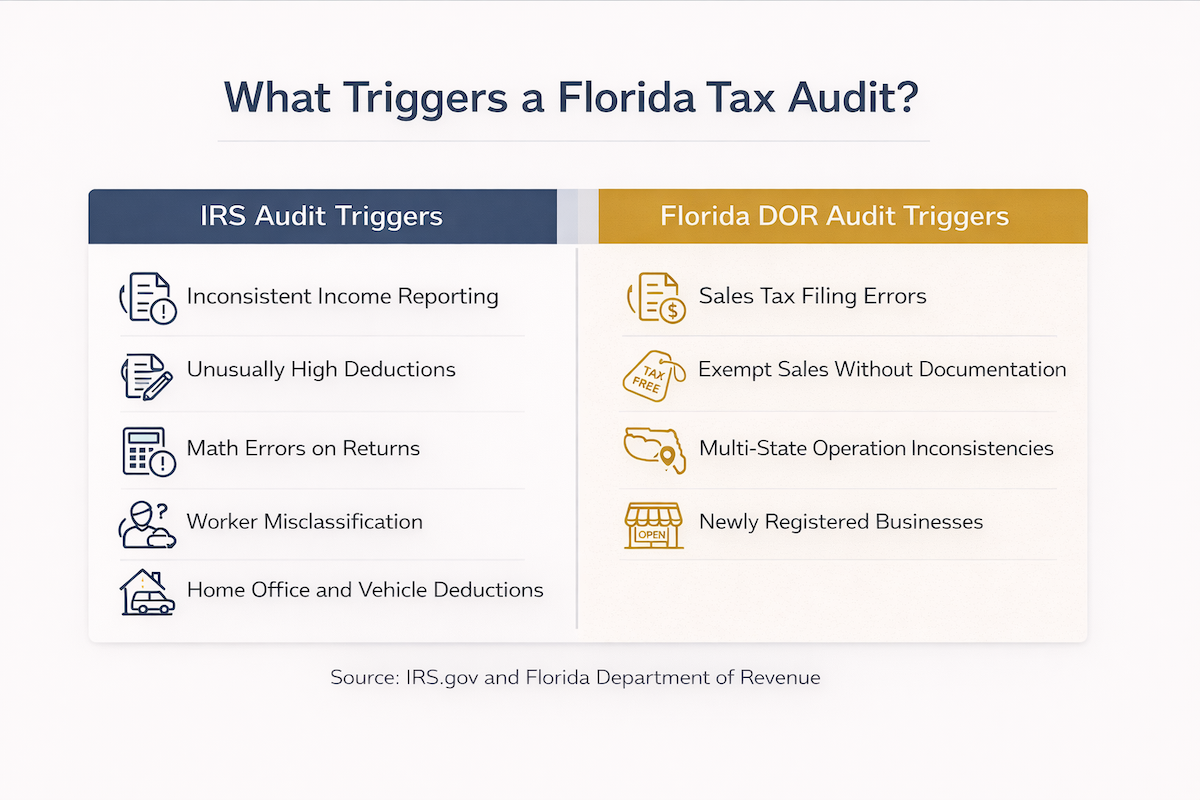
The IRS uses automated systems to flag returns that fall outside normal patterns for a given industry or income level. The most common triggers for Florida small businesses include:
- Inconsistent income reporting — significant swings in revenue or profit from one year to the next without a clear explanation
- Unusually high deductions — claiming deductions that are large relative to gross income or out of step with similar businesses in your sector
- Math errors on filed returns — even minor calculation mistakes can prompt a closer look
- Misclassification of workers — reporting employees as independent contractors to reduce payroll tax obligations is a consistent IRS focus area
- Home office and vehicle deductions — these are frequently scrutinized because they are easy to over-claim
For a full breakdown of what puts businesses at risk, see our guide on common audit triggers.
Florida-Specific Audit Triggers
Because Florida has no state income tax, the DOR focuses its audit activity almost entirely on sales tax compliance. Florida businesses in retail, hospitality, construction, and professional services are among the most frequently audited.
Common DOR triggers include:
- Sales tax filing errors or omissions — Florida’s 6% base sales tax rate (plus applicable county surtaxes) applies to a wide range of transactions, and misreporting is the leading cause of state audits
- Exempt sales without proper documentation — claiming sales tax exemptions without maintaining valid exemption certificates is a significant risk
- Businesses operating across multiple states — Florida companies with out-of-state operations often have inconsistencies in how they allocate income and expenses, which can attract attention from both the DOR and the IRS. Our guide on multi-state tax filings covers this in more detail
- Newly registered businesses — the DOR routinely audits businesses in their first few years to verify they have set up sales tax collection correctly
Florida DOR Audits vs. IRS Audits: Key Differences
These are two separate processes with different scopes, timelines, and appeal paths. Many Florida small business owners assume a “tax audit” means the IRS, but state audits from the DOR are more common for businesses that collect sales tax.
| Florida DOR Audit | IRS Audit | |
|---|---|---|
| What’s reviewed | Sales tax, use tax, documentary stamp tax | Federal income tax, payroll tax, self-employment tax |
| Initiated by | Florida Department of Revenue | Internal Revenue Service |
| Typical notice period | 30 days before audit begins | Varies; mail audits may require a 30-day response |
| Common format | Field audit (on-site review) | Correspondence, office, or field audit |
| Appeal process | Informal conference, then formal hearing with the DOR | IRS Independent Office of Appeals, then Tax Court |
| Penalty for late sales tax | 10% of tax due, plus interest | Varies by issue; accuracy penalties typically 20% of underpayment |
Understanding which type of audit you are dealing with shapes everything from which records you need to gather to who handles your appeal. If you have received a notice and are unsure of the source, a CPA with audit experience can help you identify it quickly. See our overview of what to expect from a Tampa audit for more context.
The Florida Tax Audit Process, Step by Step
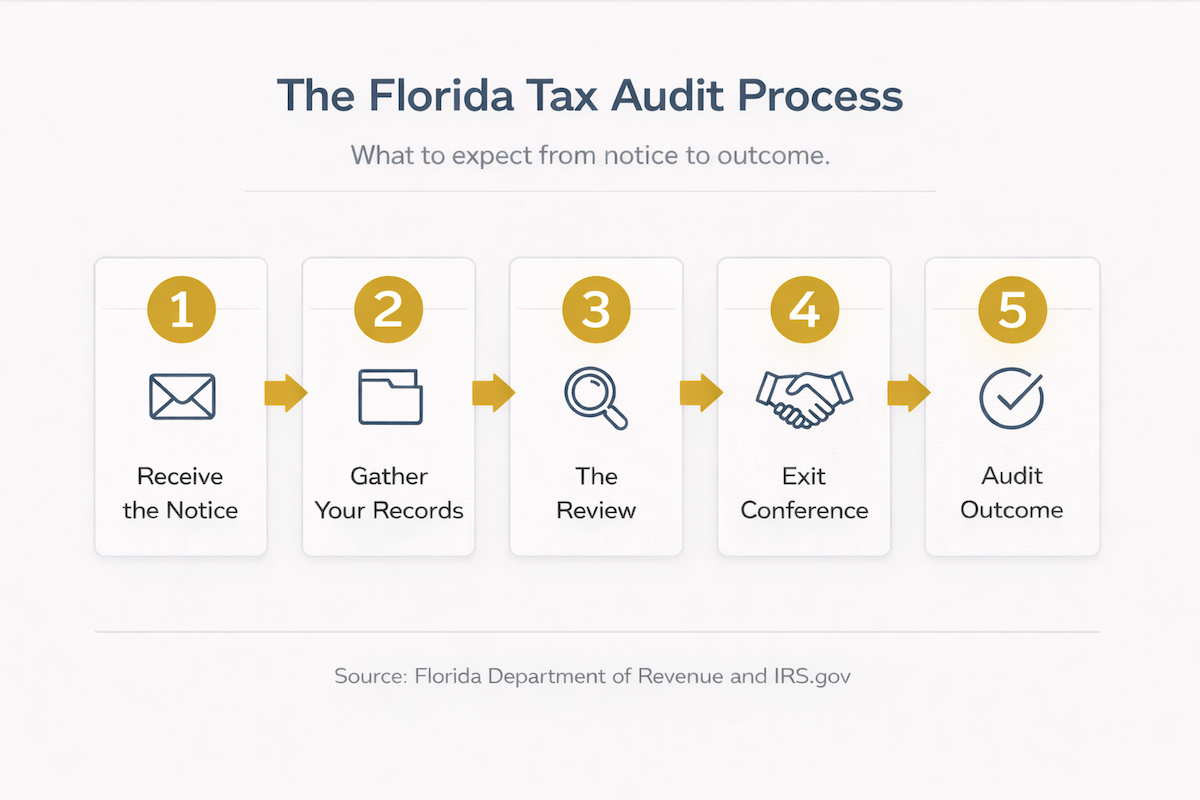
Step 1: Receiving the Notice
Both the IRS and the Florida DOR notify businesses by mail. Read the notice carefully before doing anything else. It will tell you:
- Which tax type and time periods are under review
- What documents or information are being requested
- The deadline to respond or schedule the audit
- Contact information for the assigned auditor
Do not ignore or delay responding. Auditors treat non-responses as uncooperative, which can expand the scope of the review.
Step 2: Gathering Your Records
Auditors will issue a written document request list. Typical items include bank statements, sales records, invoices, receipts, payroll records, general ledgers, and exemption certificates (for DOR audits). Organize everything systematically before submission. For tips on maintaining records that hold up under scrutiny, see our guide on how to maintain accurate financial records.
Step 3: The Review
For field audits, an auditor will visit your place of business to examine records. For correspondence or office audits, you submit documents by mail or in person. During the review, answer questions honestly and provide only what is asked. Volunteering additional information can expand the audit’s scope unnecessarily.
Step 4: Exit Conference and Findings
Once the review is complete, you are entitled to an exit conference to discuss preliminary findings before the audit is finalized. This is a critical step. Bring your CPA or tax representative. If the auditor has misunderstood a transaction or misapplied a tax rule, this is the opportunity to correct it with supporting documentation before any assessment is issued.
Step 5: Audit Outcome
The audit will result in one of three outcomes: no change to your tax liability, additional taxes owed (with interest and penalties), or a refund if the auditor finds you overpaid. If you disagree with the findings, you have the right to appeal.
Florida Sales Tax Audits: What Small Businesses Need to Know
Sales tax is the single most common reason Florida businesses face a DOR audit, and it deserves specific attention.
Florida’s 6% state sales tax applies to most retail sales of tangible personal property and certain services. Counties add their own surtaxes, which range from 0.5% to 2.5% depending on location. Businesses that collect sales tax are acting as tax agents for the state, and the DOR takes compliance seriously.
The most common sales tax audit issues for Florida small businesses are:
- Collecting the wrong rate due to county surtax errors
- Failing to collect tax on taxable services (landscaping, cleaning, commercial pest control, and others are taxable in Florida)
- Claiming exemptions without keeping valid, signed exemption certificates on file
- Failing to remit use tax on items purchased out of state and used in Florida
For more on how sales tax rules apply to service businesses, see our article on Florida sales tax for service businesses.
How to Prepare for a Tax Audit in Florida
Pre-Audit Checklist
- Read the notice and identify whether it is from the IRS or the Florida DOR
- Note the deadline for responding and add it to your calendar immediately
- Contact a CPA or tax professional with audit representation experience
- Pull all records for the tax periods under review
- Organize documents by category (bank statements, invoices, payroll, sales records)
- Cross-reference your filed returns against source documents for accuracy
- Identify and explain any gaps in documentation before submission
- Designate a single point of contact for all audit correspondence
- Attend the exit conference with professional representation
Keep Records That Hold Up
The quality of your record-keeping directly affects the audit outcome. Businesses with clean, organized, and complete records tend to move through audits faster and with fewer adjustments.
At a minimum, Florida businesses should retain: bank statements, sales and purchase invoices, payroll records, exemption certificates, contracts, and general ledger reports. The IRS generally requires records to be kept for at least three years from the filing date, but in cases of substantial underreporting, that window extends to six years. The Florida DOR can audit up to three years of sales tax filings under standard circumstances.
Modern accounting software makes this much easier. Cloud-based platforms automatically organize transactions, generate audit-ready reports, and reduce the risk of errors that attract scrutiny in the first place. For small businesses without dedicated accounting staff, these tools are particularly valuable.
Penalties for Florida Tax Issues: What You Could Owe
Knowing what’s at stake makes preparation feel less abstract.
Florida DOR penalties:
- Late filing: 10% of tax due (minimum $50)
- Failure to pay: Additional 10% per month, capped at 50%
- Interest: Florida’s current interest rate applies to unpaid tax from the original due date
IRS penalties:
- Failure to file: 5% of unpaid tax per month, up to 25%
- Failure to pay: 0.5% per month, up to 25%
- Accuracy-related penalty: 20% of the underpayment if the IRS determines the error was negligent or constituted a substantial understatement
- Civil fraud penalty: 75% of the underpayment
Businesses that cooperate fully, respond on time, and address issues proactively often qualify for penalty abatement or reduction. For a detailed explanation of how IRS penalties are calculated, see our guide on IRS penalties explained.
How to Appeal a Florida Tax Audit
If you disagree with the findings of an audit, you have formal appeal rights. The process depends on whether the audit was conducted by the DOR or the IRS.
Florida DOR appeals:
- Request an informal conference with the DOR within 20 days of receiving the Notice of Proposed Assessment
- If unresolved, file a formal protest within 60 days
- If still unresolved, request a hearing with the Division of Administrative Hearings (DOAH) or file a lawsuit in circuit court
IRS appeals:
- Respond to the audit report within 30 days to request an IRS Appeals conference
- The IRS Independent Office of Appeals will assign an independent officer to review the case
- If unresolved, you may petition the U.S. Tax Court (within 90 days of receiving a Notice of Deficiency)
Working with a CPA or tax attorney during the appeals process significantly improves your chances of a favorable outcome. Documentation that was not submitted during the original audit can often be introduced at the appeals stage.
How to Reduce Your Audit Risk Going Forward
Being audited once does not mean you will be audited again, but the same risk factors that triggered the first audit can do it again if left unaddressed.
File accurately and on time. Late or amended returns flag your account for additional review. Our Florida business tax deadlines guide has dates and filing requirements organized by entity type.
Conduct periodic internal reviews. Reviewing your own records quarterly, before a tax authority does, lets you catch errors and correct them before they become audit issues. These internal reviews are a core part of year-round tax planning for well-run businesses.
Get professional guidance before problems develop. A CPA who knows Florida tax law can identify compliance gaps, advise on deduction documentation, and help you build systems that reduce risk over time. For small business owners who are not sure whether they need professional help, our article on when to hire a CPA lays out the key signs.
Schedule a free consultation with a Tampa CPA who understands small business challenges. Let’s build your growth strategy together.

Frequently Asked Questions
What should I do immediately after receiving a Florida tax audit notice?
Read the notice carefully to identify whether it is from the IRS or the Florida DOR, note the response deadline, and contact a CPA with audit experience before communicating with the auditor. Gather the documents listed in the notice and organize them by category. Do not miss the deadline, even if your records are not fully ready. You can request a brief extension in most cases.
How long does a Florida tax audit typically take?
It varies. A simple IRS correspondence audit focused on one deduction can be resolved in a few weeks. A Florida DOR field audit covering multiple years of sales tax records can take three to six months or longer, depending on the complexity of your records and how quickly you respond to document requests.
What is the penalty for sales tax errors in Florida?
The DOR charges a minimum 10% late penalty on any tax due, plus interest calculated at the state’s current rate from the original due date. Repeated or willful non-compliance can result in higher penalties and, in serious cases, criminal referral.
Does the IRS share audit findings with the Florida DOR?
Yes. The IRS and the Florida DOR participate in information-sharing agreements. If an IRS audit results in additional federal taxable income, the DOR may initiate its own review of your Florida filings for the same period.